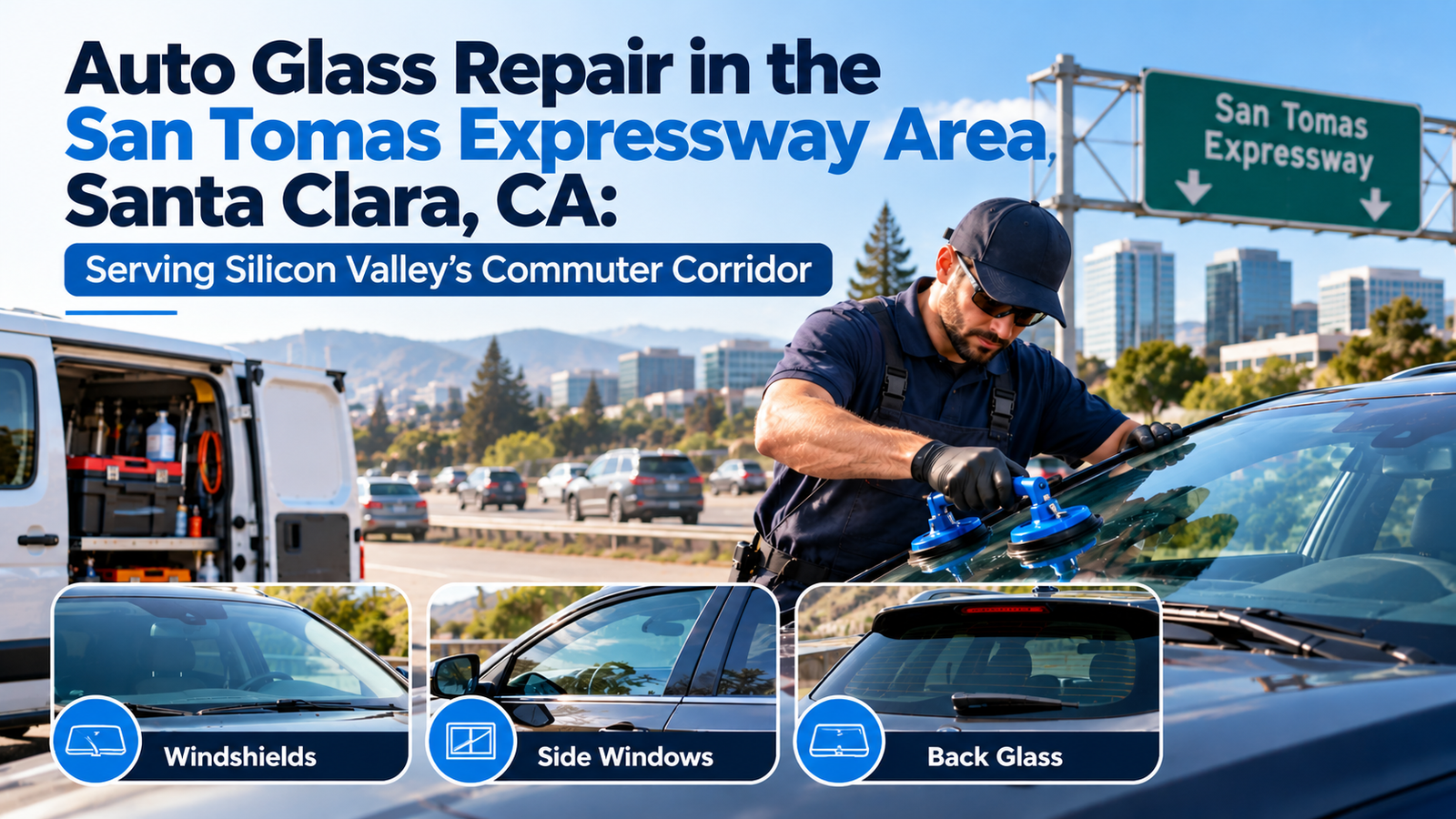
The San Tomas Expressway is one of Santa Clara County’s key arterials a county expressway running north-south through the heart of Silicon Valley, connecting Sunnyvale in the south through Santa Clara and into Campbell. The corridor around the expressway is one of the most economically productive stretches of real estate in the world: major tech campuses, semiconductor manufacturing facilities, business parks, and the dense residential neighborhoods that house the employees who work in them crowd both sides of the expressway for its entire length. Auto glass repair san tomas expressway area on this corridor comes from the high traffic volumes, the construction activity constantly changing road surfaces, and the highway-speed operation of the expressway itself where debris impacts are more energetic than on city streets.
The San Tomas Expressway’s Road Environment
County expressways in Santa Clara County including San Tomas are maintained by the Santa Clara County Roads and Airports Department and are built to expressway standards rather than city street standards: higher design speeds, at-grade or grade-separated intersections, limited driveway access, and the traffic volumes that come with serving as regional arterials. The expressway’s higher operating speeds mean that road debris impacts on windshields carry more energy than equivalent impacts on city streets, making chip and crack damage from rocks and road debris a common occurrence for regular San Tomas commuters.
The business parks, office campuses, and industrial facilities along the San Tomas Expressway corridor generate significant truck traffic delivery vehicles, construction trucks, and service vehicles accessing the industrial and commercial properties that line the corridor. Trucks are disproportionate sources of road debris impact damage: loose material from truck beds, rocks picked up from construction sites, and retread fragments from commercial truck tires all create windshield impact hazards for vehicles following in traffic.
Santa Clara County’s climate warm, dry summers and mild, wet winters creates a moderately demanding environment for auto glass maintenance. Unlike San Francisco’s foggy conditions, the inland portions of Santa Clara have lower humidity through the summer, and UV exposure is more intense. The thermal cycling between warm summer days and cooler winter nights promotes crack propagation from unrepaired chips.
Auto Glass Services for the San Tomas Corridor Workforce
The tech industry workforce that commutes through the San Tomas corridor has specific characteristics that shape auto glass service preferences. These are time-pressured, highly mobile workers with late-model, technology-equipped vehicles Tesla, BMW, Audi, Mercedes, Rivian, and a wide range of ADAS and EV platform vehicles are ubiquitous in Silicon Valley’s tech employee parking lots. Mobile auto glass service repair or replacement at the workplace rather than requiring a trip to a shop aligns well with this workforce’s preference for minimal disruption to their work schedule.
The large tech campuses along the San Tomas corridor typically have extensive parking facilities and relatively liberal policies regarding on-site vendor services. Mobile auto glass technicians routinely service vehicles in the parking areas of tech campuses in Santa Clara, Campbell, and the surrounding areas. The size of these parking lots provides adequate space for mobile installation work, and a windshield replacement can typically be completed in the time it takes for a work meeting.
ADAS Recalibration in Silicon Valley’s Vehicle Fleet
The San Tomas Expressway area’s vehicle fleet is arguably the most ADAS-dense in the world the combination of tech industry employment, high income levels, and the early-adopter orientation of Silicon Valley’s workforce means that a higher proportion of vehicles in this area have advanced driver assistance systems than virtually anywhere else. Every major ADAS platform is represented: Tesla Autopilot, Mercedes PRE-SAFE, BMW Active Driving Assistant, Subaru EyeSight, Honda Sensing, and the ADAS packages from every other major manufacturer.
For auto glass technicians serving this market, ADAS recalibration proficiency is not optional it is table stakes. A technician who can perform windshield replacement but cannot handle or coordinate ADAS recalibration cannot effectively serve most of the vehicles in this market. Static recalibration capability for the most common systems, and established referral relationships with dynamic calibration resources for systems requiring a calibration drive, are the practical requirements for competent service in the San Tomas corridor.
EV-specific windshield considerations are also relevant in this market. Tesla vehicles, which are extremely common in Silicon Valley, have specific windshield specifications for the camera systems supporting Autopilot and Full Self Driving features. The replacement glass must be compatible with Tesla’s camera system requirements, and recalibration must be performed through Tesla’s process. Other EV platforms Rivian, Lucid, Ford F-150 Lightning, and the growing range of other EVs also have their own glass and recalibration specifications.
California BAR and Consumer Protections Along the Corridor
Auto glass businesses operating in the San Tomas Expressway area in both Santa Clara and San Jose along the corridor’s extent are subject to California BAR (Bureau of Automotive Repair) registration and the consumer protection requirements of the California Business and Professions Code. Written estimates, authorization before exceeding estimates, and disclosure of glass type (OEM, OEE, or aftermarket) are required. Santa Clara County drivers have the same right as all California drivers to choose their auto glass provider regardless of insurer network recommendations.
Frequently Asked Questions: Auto Glass Repair in the San Tomas Expressway Area
Why does commuting on the San Tomas Expressway cause windshield chips?
The expressway’s higher operating speeds mean that when a rock or piece of road debris is projected into the air by a preceding vehicle, it strikes the following vehicle’s windshield with more energy than the same debris would at city street speeds. The truck traffic on the corridor delivery and construction trucks with loads or tires that shed debris is a particularly significant source. The resulting impacts are more likely to penetrate the outer glass layer and create chips than lower-speed equivalent impacts.
Can windshield replacement be done at tech company parking lots in the San Tomas corridor?
Yes mobile auto glass technicians routinely service vehicles at tech company parking facilities in Santa Clara and the surrounding communities. Most large tech campus parking lots have adequate space for mobile installation work, and companies generally permit on-site vendor service for employees. The mobile technician brings all needed equipment and materials to the vehicle’s location. The installation can typically be completed within a standard work period, and the vehicle is ready to drive home after the safe drive-away time has elapsed.
How does the San Tomas corridor’s high Tesla concentration affect auto glass service?
Tesla vehicles have specific windshield and glass requirements related to their Autopilot and FSD camera systems. Replacement glass must be compatible with Tesla’s camera system specifications, and camera recalibration must follow Tesla’s defined process either through a Tesla service center or authorized process. Mobile technicians serving the San Tomas corridor who regularly work on Teslas are familiar with these requirements. The high Tesla concentration in this market means this knowledge is an essential competency for auto glass service in Silicon Valley.
What is the difference between static and dynamic ADAS recalibration?
Static recalibration is performed with the vehicle stationary. A target board is placed at a specified distance and position in front of the vehicle, and diagnostic software uses this reference to reset the camera’s calibration parameters. It can be performed in the parking lot or workplace where the windshield was replaced. Dynamic recalibration is performed while driving: the vehicle is driven at highway speeds on a road with clear lane markings, and the camera system calibrates itself to the actual road environment. Some vehicles require one type, some the other, and some require both. The vehicle manufacturer’s specification determines which is needed for a given make and model.